
Choose object detection when rectangular boxes provide enough location information. Choose image segmentation when the workflow needs pixel-level regions, precise boundaries, or separate masks for individual objects.
The Core Difference: Bounding Boxes vs Pixel-Level Masks
Object detection identifies and localizes one or more objects, typically returning a class label and a rectangular bounding box for each result. This output can answer questions such as where an object is and how many objects appear in an image.
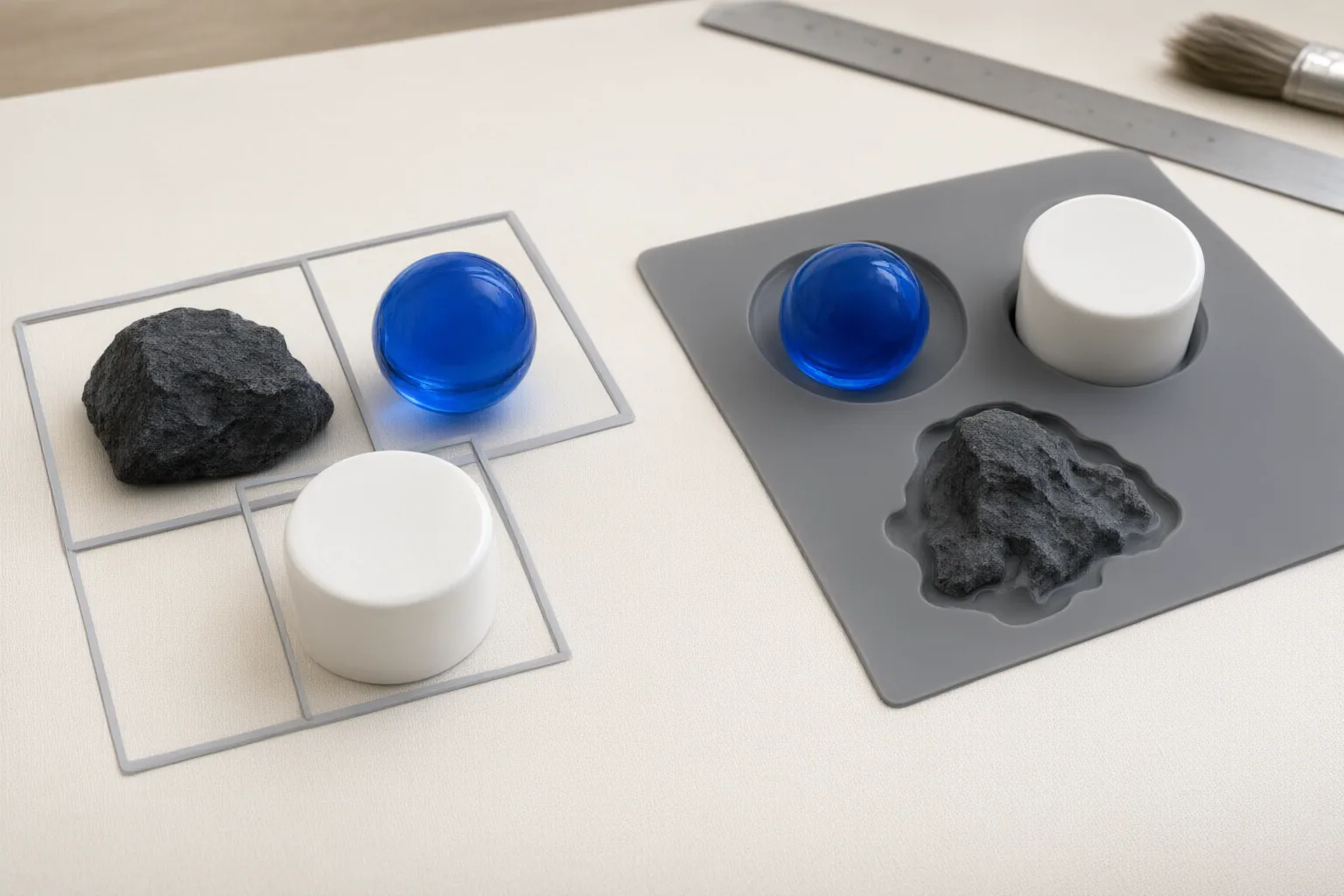
Image segmentation labels pixels instead. Its masks or regions describe shapes and boundaries more precisely than rectangles can. That distinction matters when a workflow depends on an object's curved or irregular outline, area, perimeter, or boundary. A box may include background pixels and does not reproduce the exact edge of the object, so it is not an adequate substitute for a mask in boundary-sensitive work.
The practical choice begins with the required output: approximate rectangular locations point toward detection, while detailed regions and outlines point toward segmentation.
When to Use Object Detection or Image Segmentation
Use object detection when the project needs to locate, count, or track objects and a rectangular approximation is sufficient. For example, a workflow may only need to establish that an object is present and identify its general position. In that case, pixel-by-pixel boundaries would provide detail the downstream task does not require.
Consider segmentation when later processing depends on detailed regions, object shapes, or boundaries. The supplied sources describe uses in medical imaging, manufacturing, robotics, and scene understanding, but an industry label alone should not determine the method. The deciding factor is what the application must do with the output.
Robotic manipulation illustrates this distinction. MIT course notes describe instance segmentation as useful for isolating an individual object's relevant image or point-cloud region before grasping or pose-estimation steps. Similarly, a manufacturing task concerned with a defect edge may need a mask, while a task that only locates items may be served by boxes.

Selection Checklist and Common Questions
Evaluate the project in this order:
- Required output: Decide whether the consumer of the model needs boxes, class-level pixel regions, or a separate mask for every object.
- Boundary precision: Check whether approximate position is acceptable or whether shape, area, perimeter, defect edges, or other exact boundaries affect the result.
- Same-class objects: If multiple objects from one class must remain distinguishable, class-level semantic regions are insufficient; instance segmentation separates them.
- Annotation requirements: Bounding-box and pixel-level annotations are not interchangeable. Segmentation labels contain richer detail, and the supplied sources characterize segmentation workflows as more resource-intensive or computationally demanding.
- Downstream processing: Work backward from counting, tracking, measurement, manipulation, or scene-understanding needs instead of selecting a method by name.
These sources support conceptual distinctions and application examples. They do not establish universal rankings for performance, accuracy, speed, or cost, so those factors require project-specific evaluation.
Conclusion
Choose object detection when labeled bounding boxes fully answer the task. Choose semantic segmentation when the workflow needs pixel-level regions by class, and choose instance segmentation when it must isolate individual objects of the same class with separate masks.
Before committing to an annotation and modeling workflow, document the exact output the downstream process needs: boxes, class-level regions, or individual-object masks. Use that requirement to scope the labels and evaluate the appropriate approach.
Disclosures and limitations
- This article was prepared with AI assistance from the supplied research package and its identified explanatory sources and course notes; no independent product testing was performed.
- No products are recommended here, and no affiliate relationship informed the comparison. Any future product recommendations should disclose relevant commercial or affiliate relationships.
Sources
- Object Detection vs Object Recognition vs Image Segmentation – GeeksforGeeks — GeeksforGeeks
- Image Segmentation vs Object Detection: Key Differences (2026) — datavlab.ai
- Semantic Segmentation vs Object Detection: Differences | Keymakr — Keymakr
- Object Detection vs Image Segmentation — Webbycrown Solutions
- Object Detection vs Object Recognition vs Image Segmentation | i2tutorials — i2tutorials
- Key — mindkosh.com
- Image Classification vs Object Detection vs Segmentation — GeoWGS84.ai
- Ch. 9 – Object Detection and Segmentation — manipulation.csail.mit.edu
Improve this guide
Report a problem or suggest the next question
Submissions enter a private editorial queue. They are reviewed and deduplicated before any public update or new page is created.