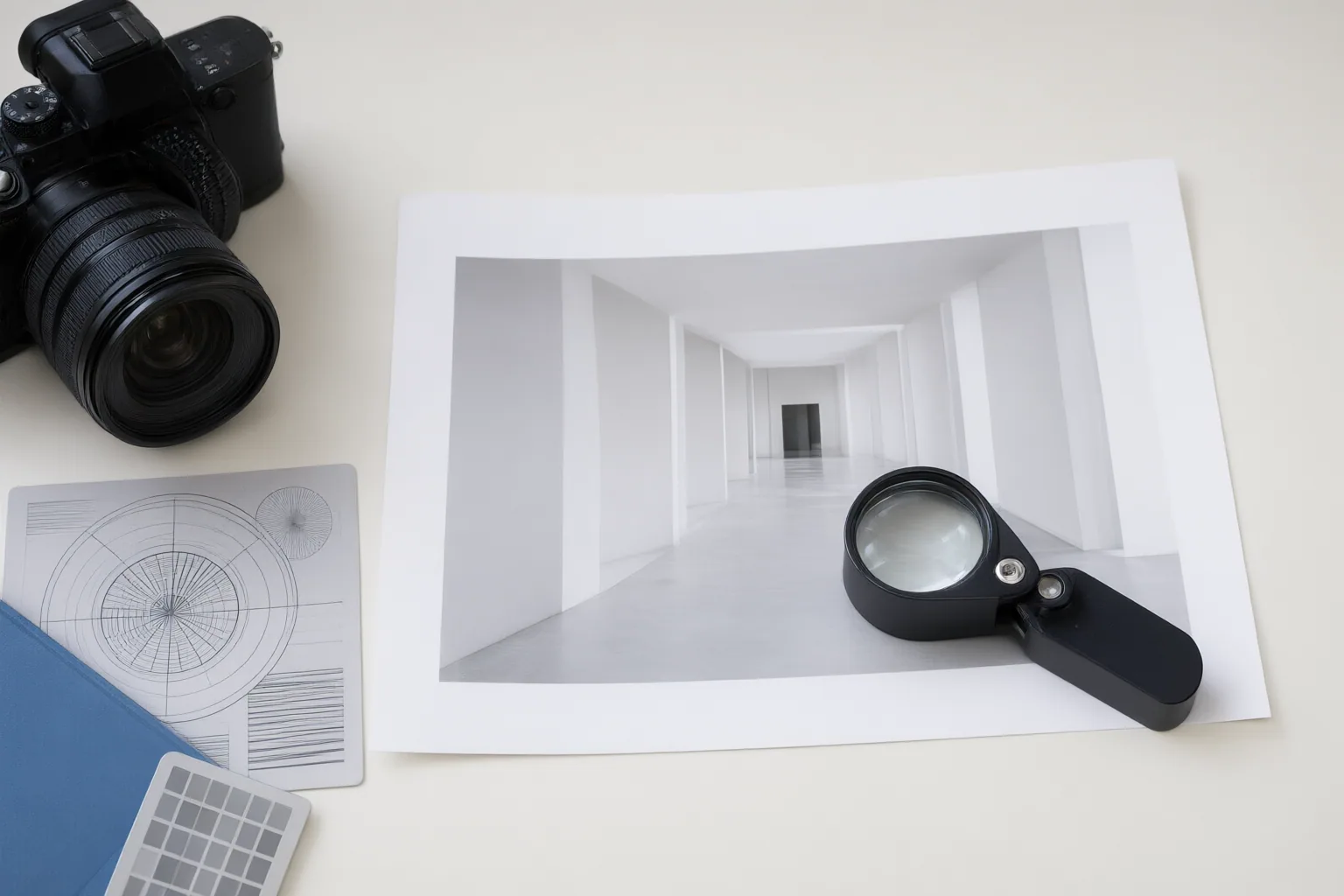
Compare representative frames for consistent field of view, apparent magnification, depth of field, distortion, and perspective. This practical framework evaluates visible changes; it does not recover actual camera settings or prove that any AI video tool preserves them.
Define the Lens Characteristics to Compare
Start with observable qualities rather than assumed camera metadata. Focal length, expressed in millimeters, relates to the distance between a lens’s optical center or focal point and the image sensor. Shorter focal lengths produce a wider angle of view, while longer focal lengths produce a narrower view and greater magnification. A prime lens has a fixed focal length; a zoom lens has a variable focal length.
Aperture controls how much light passes through a lens, and a lower f-number represents a larger aperture. Its visible relevance here is depth of field: a wider aperture can isolate a focused subject against a softer background, while a smaller aperture can leave more of the frame in focus.
For AI video evaluation, translate these concepts into questions about visible consistency. Does the frame retain the reference image’s angle of view and apparent magnification? Do the subject, foreground, and background keep comparable sharpness relationships? This approach evaluates appearance without claiming to identify the generated video’s actual focal length, aperture, or lens.
Check Framing, Field of View, and Apparent Magnification
Choose representative video frames, including the opening frame and moments with noticeable motion. Compare each with the reference at a similar display size. Mark stable landmarks such as frame edges, the subject’s size, and the amount of background visible.
Use a simple checklist:
- Note whether the video shows more or less of the scene than the reference.
- Compare the subject’s apparent size against nearby objects and background features.
- Record whether those relationships change gradually, abruptly, or inconsistently across frames.
- Separate deliberate reframing from unexplained changes that resemble zooming or camera movement.
The conceptual baseline is that shorter focal lengths correspond to wider views, while longer focal lengths correspond to narrower views and greater magnification. A generated frame that progressively narrows its view or enlarges the subject may therefore resemble a focal-length change. That observation alone does not establish what caused the change.
Apply the same frame-selection rules and comparison criteria to every output. Consistent inputs and observations make differences easier to document, although the supplied evidence does not establish a validated score or tolerance for acceptable variation.
Inspect Focus Relationships, Distortion, and Perspective
Divide the scene into foreground, main subject, and background. In the reference image, identify which areas appear sharp and which appear soft. Then review representative video frames for changes such as a previously blurred background becoming uniformly sharp, background softness shifting unpredictably, or important subject details losing focus while surrounding areas remain sharp.
This comparison is grounded in aperture-related depth of field: a wider aperture can produce a focused subject with a softer background, while a smaller aperture can keep more of the scene in focus. It remains a visual assessment, not proof of a particular f-number.
Next, inspect straight lines, frame edges, faces, and the spacing between objects. Look for bending, stretching, compression, or changing spatial relationships. Some optical behavior can be intentional: fisheye lenses are associated with ultra-wide distortion, while tilt-shift lenses provide perspective control. Preserve that context when judging the reference. A stable curved-line pattern may belong to its lens character; a shape that changes inconsistently from frame to frame may instead be recorded as generated deformation.
The cited material explains photographic characteristics but does not show how any AI video product handles them. Treat these checks as a repeatable editorial framework, not as product-test findings.
Conclusion
Evaluate lens consistency across five visible dimensions: field of view, apparent magnification, foreground-to-background focus relationships, distortion, and perspective. Record where each characteristic stays stable and where it changes over time. Avoid translating those observations into unsupported claims about actual camera settings or a tool’s underlying process.
This checklist synthesizes established photographic concepts, but it is not a validated AI-video benchmark and does not demonstrate that any particular tool preserves lens characteristics. Run it on representative frames from each output, use identical criteria and inputs for every comparison, and document the visible changes before deciding between tools.
Disclosures and limitations
- This article was prepared with AI assistance using only the cited source material. The sources explain photographic lens concepts; they do not provide AI-video product tests, benchmarks, prices, ratings, or proof that any specific tool preserves lens characteristics.
- No product or affiliate recommendation is made here. Any future commercial relationship or affiliate link should be disclosed alongside the relevant recommendation.
Sources
- Major Optical Characteristics of Lenses – Avantier Inc. — Avantier Inc.
- Understanding Lenses: Unraveling Optical Characteristics – Shanghai Optics — Shanghai Optics
- Understanding Different Types of Camera Lenses and Their Uses — ExpertPhotography
Improve this guide
Report a problem or suggest the next question
Submissions enter a private editorial queue. They are reviewed and deduplicated before any public update or new page is created.