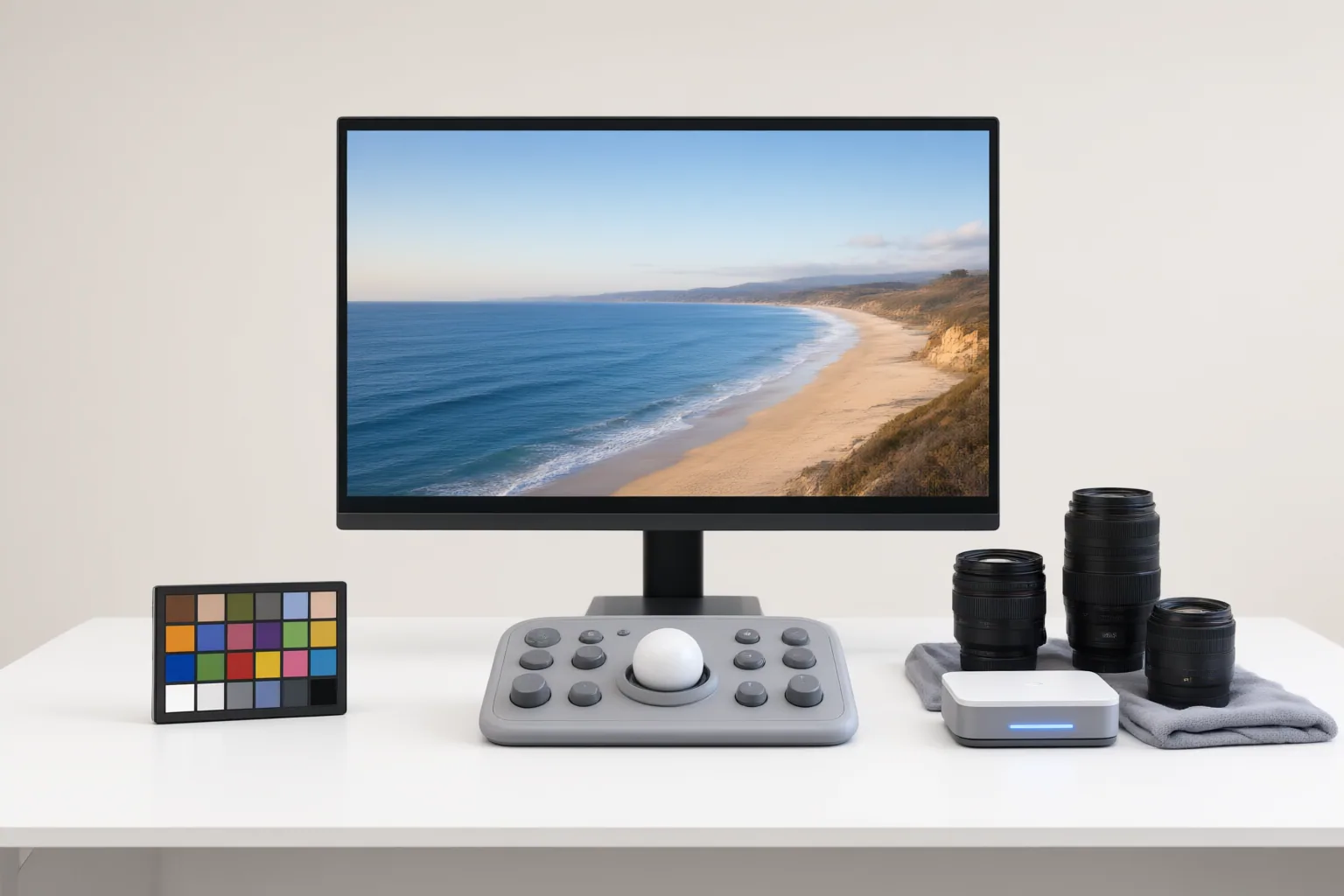
Video scopes can provide a measurement-oriented review layer after an AI-assisted color operation, but the editor must still distinguish technical correction from creative grading and verify consistency between shots. The supplied evidence does not establish Premiere or Final Cut Pro as the scope-based winner.
What Video Scopes Check in an AI-Assisted Grade
AI assistance does not remove the need for editorial review. Current AI tools in major professional editors are generally described as discrete features used for bounded operations; after each operation, control returns to the editor.
Start by identifying the intended result. Color correction concerns technical normalization, color grading concerns artistic interpretation, and color matching concerns consistency between shots. Keeping these goals separate helps prevent a visually appealing treatment from hiding a normalization or continuity problem.
Luminance and chrominance are foundational concepts for evaluating color. Relevant scope types include waveform, vectorscope, histogram, and RGB parade. The evidence supports using these concepts as part of a measurement-oriented review, but it does not document how every scope is implemented in Premiere or Final Cut Pro. Scopes therefore inform the review rather than making the final judgment.
Premiere vs. Final Cut Pro: A Workflow-Level Comparison
The available comparison material associates Adobe Premiere with color correction and Final Cut Pro with color grading. Those broad descriptions place both applications within professional color workflows, but they do not reveal whether one offers better scope layouts, controls, measurement behavior, accuracy, or performance.
Both workflows also exist alongside AI-assisted editing features. The supplied material describes Final Cut Pro tools including Enhance Light and Color, Object Tracker, Smooth Slo-Mo, automatic reframing, and caption generation. More generally, AI tools in major professional editors are characterized as bounded features that users invoke separately before resuming editorial control.
That evidence is useful for understanding the workflow, but it is insufficient for a scope-by-scope verdict. Labels such as “color correction” and “color grading” cannot establish which application better supports a particular monitoring setup or review method. A defensible choice requires direct verification of the current versions rather than an unsupported winner.
A Practical Checklist for Reviewing AI-Assisted Color
Use a product-neutral review sequence:
- Define the goal as technical normalization, creative styling, or shot matching.
- Apply the relevant bounded AI-assisted operation while retaining control over its place in the workflow.
- Review luminance and chrominance information with the scope types relevant to the task, such as waveform, vectorscope, histogram, or RGB parade.
- Compare representative shots for consistency instead of evaluating one attractive frame in isolation.
- Decide whether the result meets the original correction, grading, or matching goal, and revise it when it does not.
For a fair application comparison, use the same clips and goals in both editors. Examine the available scope controls and how comfortably they fit into the review process. Do not infer detailed differences from general product labels: the supplied sources do not establish equivalent scope configurations or provide verified comparisons of layout, controls, measurement behavior, accuracy, or performance.
Conclusion
Premiere and Final Cut Pro both belong in professional editing discussions that include color work and AI-assisted features. However, the supplied evidence does not support declaring a scope-by-scope winner. Test the current versions with identical representative clips and correction goals, then verify the controls needed for your normalization, creative grading, and shot-matching tasks before choosing an editor.
Disclosures and limitations
- This article was drafted with AI assistance using only the supplied research package and its attributed source IDs; no hands-on product testing or independent feature verification was performed.
- No affiliate product recommendation is made. Any future commercial relationships should be disclosed before adding purchase recommendations or affiliate links.
Sources
- 2026 Final Cut Pro AI vs Premiere Pro: Best AI Video Tools Compared // ZUKCLOUD ZUKCLOUD Engineering Blog — ZUKCLOUD
- VidioPics — Best Video Creation & Editing Tools — VidioPics
- Adobe Premiere vs Final Cut Pro 2026 — aitooldiscovery.com
- Premiere vs Final Cut vs Resolve AI Features | AVE — AVE
Improve this guide
Report a problem or suggest the next question
Submissions enter a private editorial queue. They are reviewed and deduplicated before any public update or new page is created.